

The Academic Job Market Guide
This series covers my experience in the academic job market for R1 tenure-track positions. It's both catharsis and a guide to share what I've learned with folks before their job market season, and for those about to embark on it.
Table of Contents
Section 1: Intro & Context
Professional Context
I am a developmental psychologist by training. Before earning my Ph.D. from the Institute of Child Development at the University of Minnesota, I worked in nutrition intervention research at Cornell University. I do interdisciplinary research on stress and nutrition. I have a doctoral minor in epidemiology, which I pursued with the idea I could be a psychologist in a nutrition/public health department or a nutrition person in a psychology department. I applied primarily to R1 tenure-track psychology departments, though I did apply to some medical schools and some nutrition/public health departments if the job ad seemed like a good fit. I am currently a tenure-track assistant professor in Psychology, with an appointment in Public Health and Health Sciences and core faculty in the Institute for Cognitive and Brain Health at Northeastern University. Much of my experience is probably most applicable to psychology and adjacent fields.
The Numbers
I applied to 17 faculty positions. I was invited to move beyond the initial round at five institutions. I received four invitations for preliminary Zoom interviews and three invitations for a full on-campus interview. I was offered tenure-track faculty positions from two universities and worked with my NIH Program Officer to discuss the offer letters during negotiation. I ultimately accepted a tenure-track Assistant Professor position in the Departments of Psychology and Health Sciences at Northeastern University in Boston (I deferred for a year to complete my training goals for my K99 and to give myself and my family a longer timeline to relocate).
Personal Context
I am a white, cis-gendered, and heterosexual woman with a young family and a very supportive spouse (domestic labor-wise, emotionally, and financially supportive). My family of origin is working class and does not understand academia. I felt pressure to find a TT job so we could "put down roots," be done with moving, and start earning more money to support my family financially. I share my timeline and thought process, but all of this is context-dependent on my accumulated privileges and anxieties driving my decisions. My undergraduate and MA degrees are in design & environmental psychology, and I transitioned from those degrees into a post-bac research position at Cornell doing nutrition intervention research in Zimbabwe and Zambia before I moved on to my PhD in Developmental Psychology to get training in developmental stress physiology. I only entered academia intending to become an R1 professor focused on research, which is what this guide is about. I knew that a teaching-focused institution was not a good fit for me, so I did not apply to any non-R1 positions.
The Timeline
Summer/Fall 2019 — ABD and pregnant with my first child, I wrote up my job market materials and decided to apply for "dream jobs only." I applied to about 6 and got 0 interviews of any kind. This was fine (albeit humbling) — I had a good draft of materials for the next round, and it was ambitious to be on the job market with no postdoc experience. It was also not a great time to be on the job market personally with a newborn/newly postpartum. I recommend getting started on materials earlier than you think — it takes time to pull these together, gives you a more accurate idea of how long a "real" job market season will take, and gives you time to get feedback through multiple drafts.
Summer/Fall 2020 — I graduated with my Ph.D. This was the COVID era before vaccines were available. I stayed with my Ph.D. lab as a postdoc doing study startup on an R01 I was co-I on, then started a delayed postdoc at Brown in April 2021. The 2020 job market was in shambles — very few jobs, hiring freezes everywhere. I applied to a few (maybe 3–4) and got 0 interviews again, though I did update my materials through another round of revisions.
Summer/Fall 2021 — In my first six months as a new postdoc, pregnant with my second child, submitting my K99 for the October deadline, and again applying for "dream jobs only." I had 1.5–2.5 years of postdoc funding left and knew interviewing would happen while extremely pregnant or very early postpartum — not ideal timing, but I decided to take some swings anyway. Materials went through another round of revisions. 0 interviews of any kind.
Summer/Fall 2022 — Six months postpartum, my K99 funding came through on the first round, and I was gearing up for a real job market swing. I received advice to go hard on the job market in the first year of the K99 if possible, then negotiate a delayed start if needed. The K99 is only two years, so depending on funding timing, that's only two rounds of job market seasons. I wanted to give it a solid go in year one, with the buffer of year two if nothing came through. Writing the K99 greatly improved my materials and the specificity of my next project, where I saw my career going, and what I planned for my next R01. This round was a huge success.
Section 2: Before it begins
Where Do I Want to Live?
Common advice is to "go to where the jobs are" and be as location-flexible as possible. I understood this advice but didn't fully follow it — I had funding for another two years, so I was intentional about where I applied. Before the job market season even started, my partner and I talked through our non-negotiables and what we might flex on. I made a spreadsheet of states, cities, and universities, ranked high/medium/low/will-not-apply, and used it to narrow down where to apply.
What Kind of Job Do I Want?
I was only interested in tenure-track R1 positions, primarily in psychology departments, with some applications to medical schools and schools of public health. This breaks down into a hard money vs. soft money question:
Hard money is stable, long-term funding provided by the institution — typically a salary or regular stipend.
Soft money means your salary is partially or entirely funded through grants or contracts you obtain — more flexibility, but continuous grant-writing pressure. (Always a good idea to talk candidly with others about how they are making either situation work, but especially as soft money positions are often dependent on federal funding).
My Ph.D. departments were hard-money; my postdoc at Brown was soft-money (medical school). I loved the medical school experience but realized I missed mentoring graduate students and teaching (and having a stable salary), so I focused primarily on applying to hard-money positions, while staying open to soft- or mixed-money positions if the fit was good and junior faculty seemed well-supported.
My interdisciplinary research focus also meant deciding whether to be a "nutrition" person in a psychology department or a "psychology" person in a nutrition/public health department — and looking for jobs explicitly interested in interdisciplinary work.
Tip: Look at job postings from previous job market seasons to understand the landscape (e.g., the psychjobwiki archive). Thinking through where you want to land can also inform which conferences become your "home" conferences — attending the same ones most years helps you build relationships beyond your department. Networking matters, especially with early-career folks whose experience will be more like your own.
Grant Writing Experience
I highly recommend getting grant-writing experience during your Ph.D. and postdoc — not just smaller travel grants, but the big training grants (NIH or your field's equivalent). This is the currency of the research landscape and, for many, of tenure. Writing big grants also forces you to articulate where you've come from, why you study what you study, and where you're going next — useful even outside the context of a specific grant.
My grant writing experience: NSF GRFP in year one of grad school, later dissertation fellowships, a PEO scholarship, an F32, and co-writing an R01 with my Ph.D. advisor. In my T32 supported postdoc with an amazing grant writing program, I wrote a K99/R00 — I recommend this for anyone eligible, because it clarifies your 5-year research plan, and gives you concrete evidence to departments that your work is fundable at the NIH level (and a stronger negotiating position, since the R00 brings the institution money through indirects).
Publication Pipeline
The job market takes a lot of time during a season when you must also publish. I wouldn't expect to do much research with a capital R while actively interviewing — submitting materials, prepping, interviewing, and negotiating felt like a full-time job from August through March. Your mileage may vary! But with two young children, the job market and the deliverables for my K99 meant I felt at capacity. It helped to have a publication or two already in the peer review pipeline to keep things moving.
Build Your Support Network
The academic job market is stressful and full of rejection. This is a good time to consider a therapist or mental health professional to talk through the experience. Figure out what sleep, movement, food, and habits sustain you, and build in real breaks. Build your social support network too — figure out who your cheerleaders are, who you can share good and bad news with. I had a text chain with three "lab sisters" whose encouragement, honesty, and humor kept me grounded throughout.
Self-Promotion Tips
Website: Update your site to showcase your research and outreach; make sure you have a Google Scholar profile.
Word of mouth: Reach out to mentors, colleagues, and collaborators to let them know you're on the market.
Social media: Think about how you're presenting yourself; posting about your availability can spread the word.
Headshots: Worth investing in professional photos if it's been a while — some universities offer free headshot days.
Conferences: A slide mentioning you're on the job market, with contact info, can genuinely lead to opportunities.
Section 3: Your materials
There is a lot of writing involved in the job market process. A few general rules of thumb:
Empathize with your audience — they are tired, overworked, and need to know all about you and why you're great, quickly and clearly. Not unlike grant writing.
Think about your "platform."The Professor Is In and The Early Career Researcher's Toolbox both offer useful structures for thinking about your research and context.
Write early, revise often, get a lot of eyes on your materials. General writing resources: Stylish Academic Writingand Air & Light & Time & Space, both by Helen Sword.
Written Materials
Cover letter (1.5–2 pages): Overview of who you are and why you fit the position. I wrote one template and tailored it per job.
Research Statement (2–3 pages): Your research question(s), unique contributions, methods, funding plans, and future directions. My general outline:
Who I am, what I study, and why
How I address these questions (methods) and how my research moves the field forward
3–4. First research arm — why, how, findings, why it mattersFuture directions for that arm
6–8. Second research arm — why, how, findings, why it mattersFuture directions for that arm
Wrap-up paragraph
Teaching Statement (1–2 pages): What you teach, your approach, and how you'd teach at the specific institution (I tailored the last paragraph per job).
Diversity Statement (1–2 pages): How you contribute to DEI in your current work and how you'd contribute at the future institution.
CV: Review it from a hiring committee's perspective. A useful tip from Moin Syed: link to your current work via preprints (public or via OSF).
Interview Prep
Zoom/Phone Interview
You may get a first interview as soon as a week after the review deadline — worth prepping right away. Write out and practice answers to likely questions, keep answers to about a minute, reduce jargon (your audience is highly educated but not subject-matter experts), and send a thank-you email to the search committee chair afterward.
My general platform / 5 talking points:
I am a developmental psychologist who studies early life stress and its regulation.
I focus on how early-life and intergenerational caregiving experiences shape neurodevelopment, health, and behavior.
Productive scholar with a continuously funded research program (co-I on an R01, PI on a K99/R00).
Interdisciplinary, but grounded in developmental stress research.
Teacher focused on critical thinking, empathy, and applied learning.
Additional advice: Research each faculty member and link your research to theirs. Dress professionally even for virtual interviews. Practice out loud, aiming for semi-rehearsed rather than fully scripted. Take a calming breath before answering if you're nervous.
Job Talk Slide Deck
The job talk showcases your research, teaching, and fit. Review the job ad for expectations, and clarify logistics (day, time allotted, Q&A length, whose computer you'll present from) with the search committee chair.
It takes real time to build a good job talk — I spent about three weeks total across 3–4 drafts, presenting the first draft to my lab group for feedback.
My process:
I printed my publication list, cut titles into slips of paper, and grouped them by theme/method/population rather than publication date — looking for the most compelling story of my research agenda, past and future.
I planned the structure with a captivating introduction and a clear research question to guide the audience. I opened with personal history (my path from a construction worker's kid to design student to researcher), using architecture as a metaphor for studying early-life stress. I spent real time on the big-picture "why" before diving into results, then built through three areas of research toward future directions and funding plans.
I kept slides visually clean — minimal text, strong visuals, bullet points for key ideas — since the deck should support the talk, not act as a script.
I practiced 5–10 times, enough to feel natural without sounding wooden, and adapted delivery (not slides) to each audience's background.
Common interview questions to prepare for:
Why apply here?
Overview of your current research and its motivation
The big research question you hope to answer, short- and long-term plans
What unique contribution you bring
Teaching interests and preferences
Knowledge of the location
Grants you intend to pursue
Mentoring style and lab management approach
How you'll promote diversity and inclusion
Lab size and collaboration plans
Potential first projects for grad students
Your field's future direction and challenges
What you need to succeed (facilities, participant populations, staffing)
How you'd explain your research to non-specialists
What you expect grad students to learn under you
Thoughtful questions for the committee (always ask one!)
Section 4: Campus Interview Logistics
Scheduling
I scheduled my campus interviews back-to-back, traveling for about 3–4 weeks with a few days at home in between. This let me negotiate multiple offers around the same time if needed, and stay "on" for a concentrated stretch rather than re-ramping up each time. It also meant coming home, doing laundry, and repacking immediately. Interviews are time-consuming; rest as much as you can before and after.
Rough Outline of a Campus Visit
Day 1: Arrival & Dinner — Check-in, then an informal dinner with a few faculty members and/or graduate students (this is informal but still part of the interview).
Day 2: Job Talk, Individual & Group Meetings — Welcome breakfast, possible campus/lab tour, individual faculty meetings, the job talk itself (typically 45–60 minutes plus 10–15 minutes Q&A), lunch with grad students, more faculty meetings, and a department dinner.
Day 3: More Meetings — Similar to Day 2 without the job talk. Meetings with additional faculty, research center tours, meetings with departmental leadership on role expectations and tenure process, possibly university administrators, and wrap-up meetings before departure.
Post-Visit
Send thank-you emails to everyone you met. I took notes each evening about what excited me and any lingering questions, and debriefed with my partner nightly.
Prepping for the Campus Interview
I built research documents on the department, graduate students broadly, related research centers, other departments I might collaborate with, the university as a whole, and the surrounding town/city — plus an individual cheat sheet for every person I was meeting. This took 3–5 days of prep per campus interview (not including job talk practice), and for each person involved reviewing their website/lab site, checking recent grants via NIH RePORTER, reading a handful of their most-cited and most recent papers, and occasionally listening to any podcast interviews they'd done as an efficient way to combine prep with exercise.
Want the specifics on what to pack and what to wear for a multi-day campus interview? See the Packing & Interview Outfit Guide →
Packing & Interview Outfit Guide
Specifics on what I packed and wore for multi-day, marathon campus interviews as a tenure-track candidate — you may read this and find it useful, you may read it and consider my psychopathology. Whatever works for you.
Pre-Work: Outfit Planning
I had ~3 days of outfits to plan for per campus visit. Coming into the 2022 job market after birthing/breastfeeding two babies and two years of working from home during COVID, my professional wardrobe was in rough shape. I wanted clothes that (1) fit and felt comfortable for marathon interview days (8am–8pm was not unusual), and (2) communicated competence and professionalism.
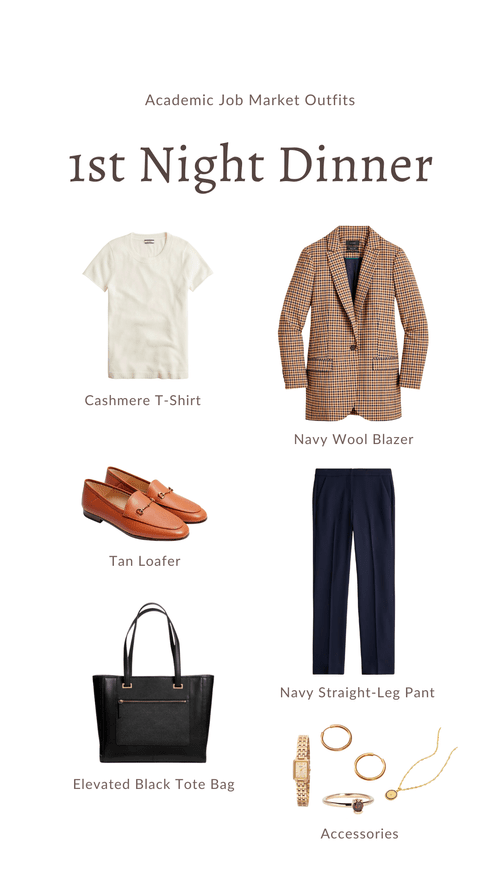
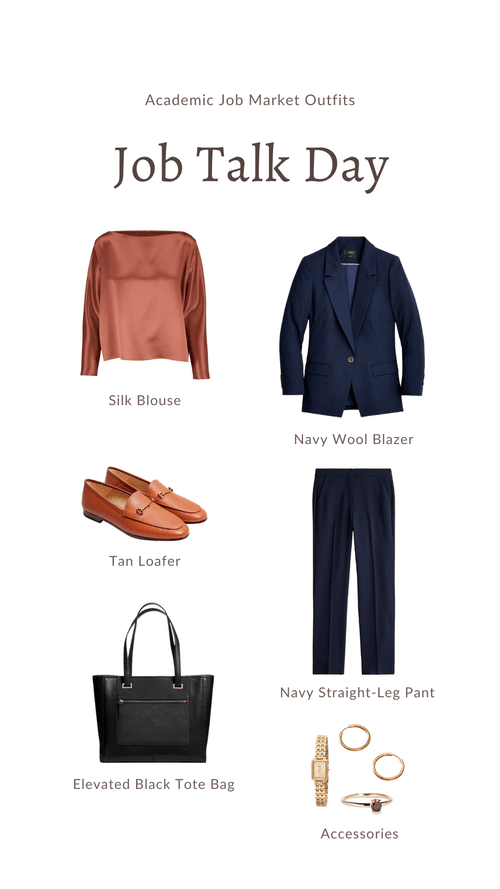
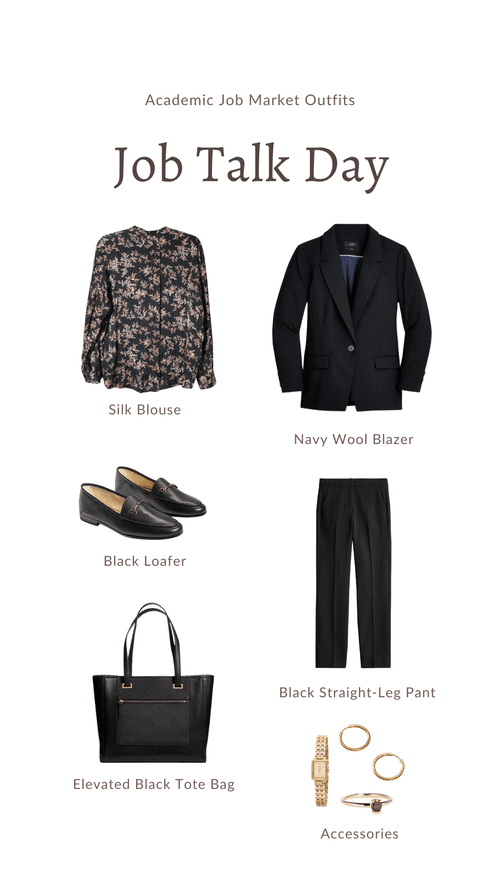
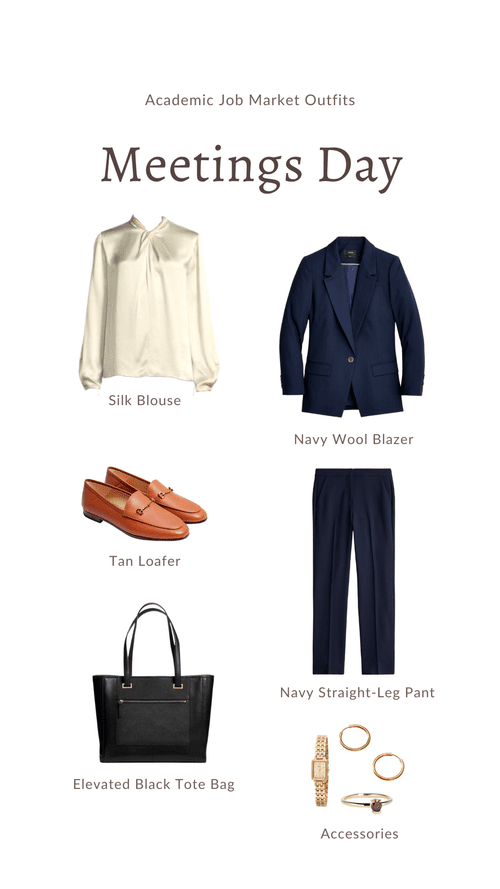
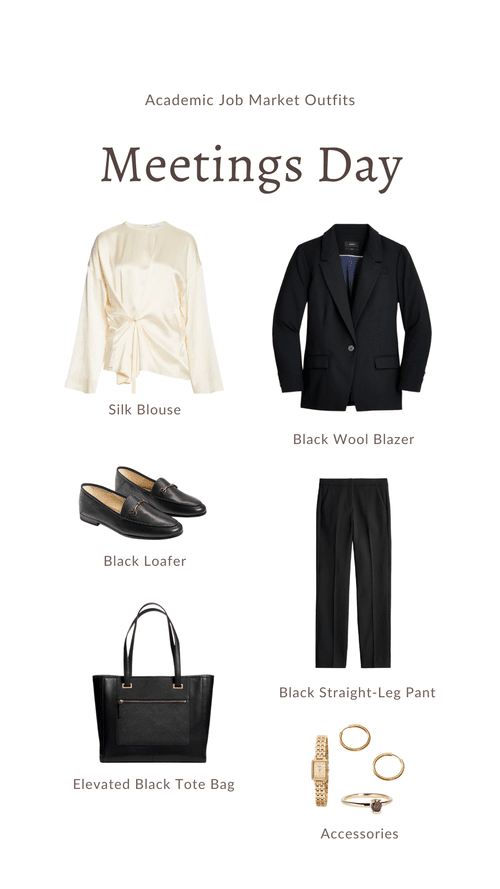
Suiting: I bought two suit pants and two matching blazers (navy and black), purchased together so the colors matched exactly. I hunted for sales, and also picked up a "fun" patterned blazer from Poshmark for a less formal Day 1 dinner outfit.
Important: I was between sizes, so I bought the larger size and had everything tailored. Buy for your body now, and find a tailor.
I got a cashmere t-shirt and searched Poshmark/eBay for otherwise expensive silk blouses — simple, crewneck (no buttons/v-necks/gaping while breastfeeding), something with a bit of visual interest (color, a knot detail, a pattern). I tried on full outfit combinations to make sure all the pieces worked together.
Shoes: Skipped heels in favor of one pair of tan and one pair of black loafers — there's a lot of walking involved.
Accessories: A leather tote bag (Lo & Sons) as a joint gift from my partner and parents. Simple jewelry — small gold hoops, a vintage gold Seiko watch, a few rings I wear regularly.
Makeup/hair: Kept it simple and consistent with what I normally wear, using cream formulas for staying power and a setting spray I trust.
What to Pack besides the basics:
Anything you need to sleep well in a strange place: eye mask, earplugs, heating pad, cozy socks, warm pajamas, tea bags of your favorite tea.
Presentation clicker + VGA adapter + USB drive with a backup copy of your talk
Notebook or printed sheet with names and a one-line note on each person you're meeting (I put this into my calendar with notes so I could glance at my phone quickly)
A small "emergency" zipper pouch with: stain-remover stick, eyeglass cleaner, tweezers, mini emery board, chapstick, painkillers, a flosser, tissues, breath mints, a bar for low blood sugar
Workout clothes for a morning walk before interviews, and comfortable and professional travel clothes in case faculty pick you up from the airport.
On Meals During the Visit
For every meal, think about what's easy to eat while socializing and answering questions. I looked ahead at menus or had a default order (Caesar salad with chicken for lunch; salmon or fish with vegetables for dinner, avoided red sauce/soup/lactose). For drinks, I followed the social cues: usually one glass of wine if others were having one, with plenty of water throughout.
Campus Interview Outfit Examples
-
![Outfit first night dinner]()
First Night Dinner Outfit
-
![]()
Job Talk Day 1
-
![]()
Job Talk Day 2
-
![]()
Meetings Day 1
-
![]()
Meetings Day 2
Section 5: Negotiations
Once you've received a job offer, the next step is navigating negotiation. This is the most leverage you'll have with an institution to set yourself up for pre-tenure success — and the people you're negotiating with aren't your enemy. They want you to succeed too.
In General
Be professional and courteous. Respond quickly, even just to acknowledge you're thinking it over.
Practice your negotiation skills with a mentor or trusted colleague beforehand.
Prioritize your needs. Rank salary, research funding, teaching load, etc., and know your non-negotiables — both for your research and for your life outside work (childcare, housing assistance, salary minimum).
Research institutional policies on salary scales, promotion timelines, and indirect kickbacks where you can. Current assistant professors are often generous with this information.
Ask for time to reflect. Don't accept the first offer immediately. My negotiations happened over calls, not in writing, until the final offer was ready to sign. It's fine to say, "Thank you for this conversation — I'll think it over and get back to you."
Startup Packages
Startup packages are pivotal — likely your major (or only) source of research funds for the first three years. Plan carefully.
How much can I ask for? This is research- and field-dependent. Connect with your network of recently hired peers to get a ballpark, and have a clear picture of what you need to succeed.
Your startup money typically covers:
Equipping and maintaining your lab
Part of your salary (summer salary for hard-money positions, more for soft-money)
Staff, student, and postdoc salaries
Preliminary data for grant proposals (assays, facilities, participant costs, instruments)
Conference, publication, and professional development costs
During negotiation, I planned out the next two studies I'd need pilot data for and built an itemized budget for each — mapping directly to what I'd need to secure a competitive R01 before tenure.
Be flexible — understand institutional limits and consider alternative solutions.
Seek guidance from mentors or colleagues who've negotiated a startup before.
Evaluate the total package, not just research resources — teaching load, administrative duties, and collaboration opportunities all matter too.
Get it in writing once negotiations are complete.
Closing Thought
Securing a good startup package is critical to launching a successful academic career — and yes, it may feel stressful and close to a panic attack at points (ask me how I know). This isn't just about resources; it's about setting the foundation for your whole academic journey. Good luck!

How I built my startup budget
(header categories, each broken into line items):
Personnel (salary + fringe + raises)
Capital equipment costs (institution-specific threshold, often items over $5,000)
Study costs — general (recruitment materials, participant registry, shipping, compliance) and study-specific (blood draw costs, assay costs, participant payments, behavioral assessment costs), broken out per planned study with aims and target N
Server space for data
Computing resources/supplies
Behavioral equipment (video camera, parent-child interaction toys, assessment furniture)
Standardized assessments
Open-access publication costs
Conference travel and society membership
Early-career mentorship/professional development